🎉 Up to 70% Off Selected ItemsShop Sale

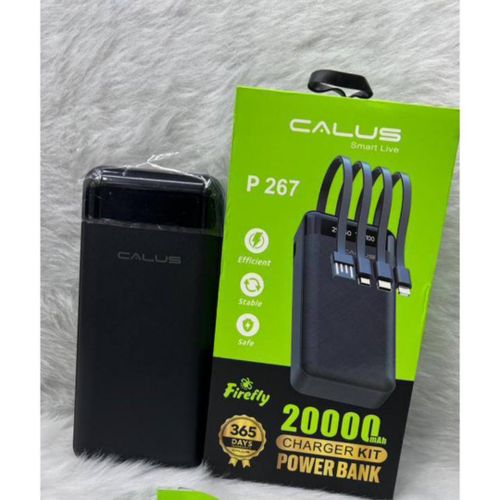
Calus P-267 Power Bank 20000 Mah
- Battery capacity: 20,000 mAh (nominal). Real usable capacity will be lower after conversion losses.
- Ports & built‑in cables:
- Common listings show up to 4 built‑in connector cables (often a 4‑in‑1 arrangement: Lightning, USB‑C, Micro‑USB and possibly a spare USB‑A cable or multi‑adapter). Exact cable set depends on region/SKU.
- Additional external USB output ports (usually one or two USB‑A ports) on many variants so you can charge extra devices simultaneously.
- Input for recharging the bank: often USB‑C and/or micro‑USB input (check the specific unit for which ports are input vs output).
- Charging performance:
- Advertised “fast charge” support on some listings (typical output power stated around 18–22.5 W on compatible ports). Exact PD/QC support varies by SKU—some list standard 5V/2.4A only.
- Bidirectional charging on units with USB‑C (used for both input and output) is common in newer variants.
- Display / indicators: LED digital percentage display is commonly shown on listings so you can see remaining battery percentage.
- Safety: typical protections advertised — overcharge, over‑discharge, short circuit, over‑current and temperature protection.
- Physical / design:
- Compact mid‑size form factor for a 20,000 mAh pack; finishes vary (matte, textured, plastic).
- Weight and exact dimensions vary with the built‑in cable arrangement—expect a pocketable but not ultra‑light device.
- Use cases: travel, daily carry for heavy phone/tablet users, powering multiple devices on the go.
- Usable energy: nominal 20,000 mAh is measured at cell voltage (~3.7 V). After boost circuitry and losses, usable capacity at 5 V USB is lower (typical usable efficiency ~60–80% depending on design). Expect enough full smartphone charges on the order of several times (exact count depends on your phone battery).
- Recharging time: depends on input specification and charger used. If the unit supports higher input current (USB‑C PD), recharge will be faster; many listings show standard 5V/2A recharge times of several hours.
$21.19
Calus P-267 Power Bank 20000 Mah—
$21.19
Product Information
Product Information
Shipping & Returns
Shipping & Returns
Description
- Battery capacity: 20,000 mAh (nominal). Real usable capacity will be lower after conversion losses.
- Ports & built‑in cables:
- Common listings show up to 4 built‑in connector cables (often a 4‑in‑1 arrangement: Lightning, USB‑C, Micro‑USB and possibly a spare USB‑A cable or multi‑adapter). Exact cable set depends on region/SKU.
- Additional external USB output ports (usually one or two USB‑A ports) on many variants so you can charge extra devices simultaneously.
- Input for recharging the bank: often USB‑C and/or micro‑USB input (check the specific unit for which ports are input vs output).
- Charging performance:
- Advertised “fast charge” support on some listings (typical output power stated around 18–22.5 W on compatible ports). Exact PD/QC support varies by SKU—some list standard 5V/2.4A only.
- Bidirectional charging on units with USB‑C (used for both input and output) is common in newer variants.
- Display / indicators: LED digital percentage display is commonly shown on listings so you can see remaining battery percentage.
- Safety: typical protections advertised — overcharge, over‑discharge, short circuit, over‑current and temperature protection.
- Physical / design:
- Compact mid‑size form factor for a 20,000 mAh pack; finishes vary (matte, textured, plastic).
- Weight and exact dimensions vary with the built‑in cable arrangement—expect a pocketable but not ultra‑light device.
- Use cases: travel, daily carry for heavy phone/tablet users, powering multiple devices on the go.
- Usable energy: nominal 20,000 mAh is measured at cell voltage (~3.7 V). After boost circuitry and losses, usable capacity at 5 V USB is lower (typical usable efficiency ~60–80% depending on design). Expect enough full smartphone charges on the order of several times (exact count depends on your phone battery).
- Recharging time: depends on input specification and charger used. If the unit supports higher input current (USB‑C PD), recharge will be faster; many listings show standard 5V/2A recharge times of several hours.